You fall asleep fine. Then, bang, wide awake. Maybe it's 3am on the dot, maybe midnight, maybe just before your alarm. Eyes open, sometimes for an hour. And it's not once in a while, it's the same time, most nights. You've tried magnesium, tried not looking at your phone, tried everything. Nothing shifts it.
Here's the thing that changed how I see this once I looked through Traditional Chinese Medicine (TCM): the hour you wake is a clue, not a coincidence. I've spent years reading and living this tradition, and this is one of its most quietly useful ideas.
The body has a clock, and the hour you wake is the clue
Traditional Chinese Medicine maps the 24-hour day onto a rotating clock, where each two-hour window is when a particular organ system does its most important work. The hour you keep waking points to a different one:
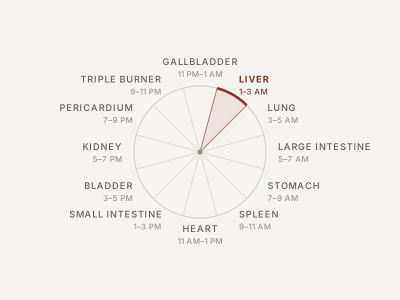
- Around midnight, 11pm to 1am: the Gallbladder.
- 1am to 3am: the Liver.
- 3am to 5am: the Lungs.
By far the most common is the middle one, the Liver, 1am to 3am, so that's the one we'll really get into. If yours is midnight or nearer dawn, hold that thought: there's a quick map for you at the end.
In TCM the "Liver" is bigger than the organ on a scan. It has two jobs that matter here: it stores your blood, your deep reserves, while you rest, and it keeps your energy and your emotions flowing smoothly. At night, as you sleep, blood is meant to "return to the Liver" so it can quietly do its repair and reset. If that process goes smoothly, you sleep through it and never notice.
But if something in that system is off, 1 to 3am is exactly the window where it shows. Your body tries to do its deepest work, can't settle into it, and surfaces you into that wide-awake state instead.
Two reasons it happens, and they're opposites
This is the part generic advice misses. Waking at 3am isn't one problem. In TCM it usually comes in one of two flavours, and they're mirror images.
1. The flow is stuck and running hot
Here the problem isn't emptiness, it's pressure. Energy that's meant to flow smoothly gets jammed up, usually by stress, frustration, resentment you've been sitting on, alcohol, or a heavy late dinner.
You wake up tense and wired, often anxious, with your thoughts racing and scattered. Dreams are vivid and easily disturbed. It often travels with a tight or congested chest, a feeling of fullness under the ribs, a bitter taste in the mouth and a restless, irritable edge. It gets noticeably worse after a stressful stretch, and after alcohol, sugar or dairy in the evening.
2. The tank is a little empty
There isn't quite enough "blood", in the TCM sense of deep reserve, for the system to settle into.
You wake with a racing or fluttery heart, dry or gritty eyes, and a weak, wrung-out feeling in your arms and legs. You're a light sleeper generally, waking at the smallest sound, with heavy or unsteady legs and a dizzy, foggy head. This is the depleted version, common in people who are run down, post-illness, dealing with heavy periods, or simply doing too much for too long.
Same 3am wake-up. Two opposite roots. Which is exactly why one person's fix, say a calming herbal night tea, soothes one and does nothing for the other.
So how do you read your own?
A quick gut-check:
- Wake anxious, tense, thoughts racing, dreaming vividly, worse with stress or alcohol? That points to the stuck and hot picture.
- Wake with a fluttery heart, dry eyes, limbs feeling weak, a light sleeper generally? That points to the running low picture.
- Many people have a bit of both. Stress on top of depletion is a very common combination.
What actually helps
The behavioural basics of sleep, timing, warmth, screens, an earlier lighter dinner, matter here too, and I've laid those out separately in sleep the TCM way. But for the 3am picture specifically, a few things aim at the Liver itself:
- Be asleep before 11pm. This is the big one. If the Liver's repair window is 1 to 3am, you want to already be deep in sleep when it opens, not still scrolling. Regularly being up past midnight is like asking the night shift to start without you.
- Don't take the day's feelings to bed. The Liver hates stuck emotion. Stewing on a frustrating day, or answering one more tense email at 10pm, is what jams the flow. A genuine wind-down moves it: a walk, a warm foot soak, writing the worry down so you can put it away.
- Go easy on alcohol and heavy late food, especially rich, greasy or very late dinners. Both land squarely on the Liver overnight and are among the most reliable 3am triggers.
- Move stuck energy in the day. Gentle, regular movement helps the smooth flow the Liver is meant to keep: walking, stretching done properly rather than rushed, qigong, yoga. Stagnation loves a still, stressed body.
- If you run empty, feed the reserves. Cooked dark leafy greens, beetroot, a little good red meat, red dates and a little brown sugar are the sorts of foods TCM leans on to nourish "blood". Think gently and consistently, as food, not as a remedy. Which of them suits you depends on your own body, so it's worth choosing to suit yours rather than working through the list.
Waking at midnight, or nearer dawn? A quick map
If your wake-up isn't 1 to 3am, the same logic still applies: a different hour, a different system. Two you'll recognise.
Around midnight, 11pm to 1am, the Gallbladder. This is the day's hinge, when your active, daytime energy is meant to sink down and hand over to deep rest. Waking here often means it can't quite let go: a mind still turning over decisions, worries or tomorrow's to-do list, unable to switch off. It's classic in people who are wired at bedtime, or who never got to sleep before 11 in the first place. The fix leans the same way as the Liver's: an earlier, genuinely calm wind-down, and not taking the day's unfinished business to bed.
3am to 5am, the Lungs. In TCM the Lungs govern your breath and, on the emotional side, grief and sadness. Waking in this window often comes with a low or heavy feeling, a worry or sense of loss you can't quite place, or shallow, restless breathing, sometimes long after whatever you were grieving has passed. It can also show up when you're run down and your reserves are thin. Here, gentle breathwork, fresh air and early-morning light help, and, if there's real grief underneath, letting yourself feel it rather than lying there fighting it.
These are the short version. Each is its own picture, and the same empty vs stuck split runs through them too, which is exactly why the hour is only the starting point.
The real answer is your whole picture, not the hour
Here's the honest limit of any article. I can tell you the hour you wake points to a system, the Liver, the Gallbladder, the Lungs, and give you two pictures to weigh yourself against. What I can't tell you from here is which one is really yours, how far it's gone, and whether there's something else tangled in with it, because that's a read of your whole picture, not a single symptom. And getting that wrong, nourishing when you needed to unstick, or the other way round, is why so much generic advice quietly fails.
A Traditional Chinese Medicine (TCM) Wellness Report shows your whole picture, reviewed by a senior TCM doctor licensed in China, and comes back as a clear, personalised plan.
This is wellness insight from the Traditional Chinese Medicine tradition, not medical diagnosis or treatment. Persistent night waking can have medical causes too. If it's ongoing, please check in with your GP.